

Gas Station Moratorium
Beyond Toxics advocates for a ban on the construction of new gas stations in Eugene
Existing gas stations pose a threat to human and environmental health and undermine state and local efforts to reduce fossil fuels.
Building new gas stations is simply not necessary. Every Eugene resident can already reach one of the city’s 56 gas stations in a five-minute drive or less. Eugene’s local utility provider, Eugene Water and Electric Board (EWEB), projects that 80% of passenger vehicles on roads will be electric by the year 2040. Analysts suspect that 80% of gas stations will be unprofitable by the year 2035.
The more gas stations we construct now, the more will be useless and will need to be demolished in the near future leaving a legacy of groundwater and soil contamination.
We must ask ourselves the question: Do we really need more gas stations?
Top 4 Reasons to Support a Gas Station Moratorium
-
Gas stations emit toxic air pollution linked to asthma, birth defects, and cancer.
-
Gas stations frequently leak petroleum contaminating nearby groundwater, soil, and air causing damage to nearby properties.
-
Economists and energy experts predict most existing gas stations will be unprofitable in the next 10 years as electric car sales continue to rise.
-
Banning the construction of new gas stations is not new and has already been done in several cities in California and is being proposed in several other large cities.
Beyond Toxics supported a 2023 moratorium on the construction of new gas stations in Eugene. Though the ban was rejected, we remain committed to protecting our community from petroleum pollution.

Why Are Gas Stations Harmful?
Harmful Chemicals
All fossil fuels, including petroleum products such as diesel and gasoline contain a multitude of chemicals toxic to human health. Most damaging are the volatile organic compounds of Benzene, Toluene, Ethylbenzene, and Xylene, collectively referred to as BTEX. Benzene is considered the most hazardous of these chemicals, because it is known to cause cancer such as leukemia, multiple myeloma, and non-Hodgkin lymphoma.
Additionally, all BTEX chemicals are associated with harm to the nervous, reproductive, immune, respiratory, cardiovascular, and fetal developmental systems. While these negative health outcomes may occur even at common levels of BTEX in our homes, schools, and public, gas stations increase the risk of exposure to higher concentrations of BTEX from chemical emissions from fueling operations.
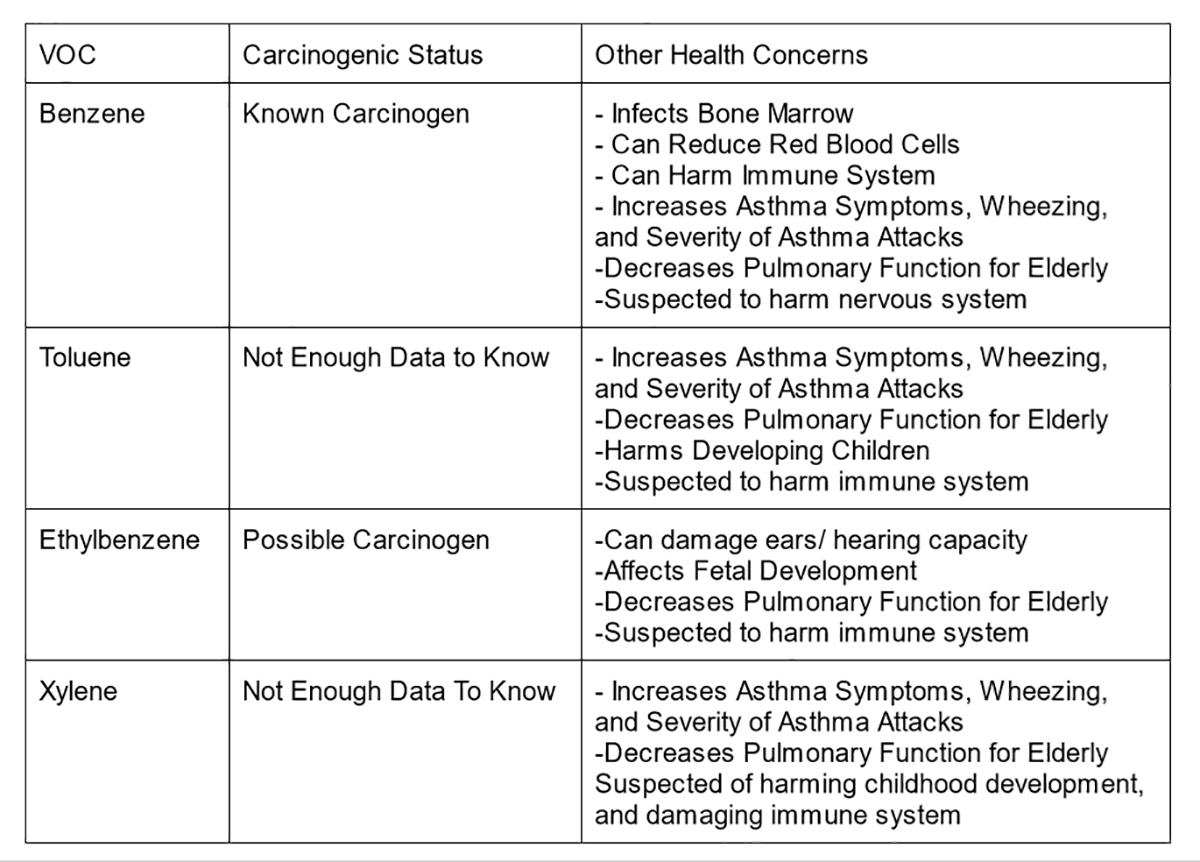
Sources: Yoon et al., 2010; Arif & Shah, 2007; Rumchev et al., 2004; Gordian et al., 2010; Delfino et al., 2003a; Delfino et al., 2003b; Billionnet et al., 2011; Hirsch et al., 1999; Bentayab et al., 2013; Sierra Club, 2004; Bolden et al., 2015)
Chronic Air Pollution
The fossil fuels on site harm the public by exposing people to volatile organic compounds (such as BTEX), which enter the nearby air, water, and soil in a variety of ways.
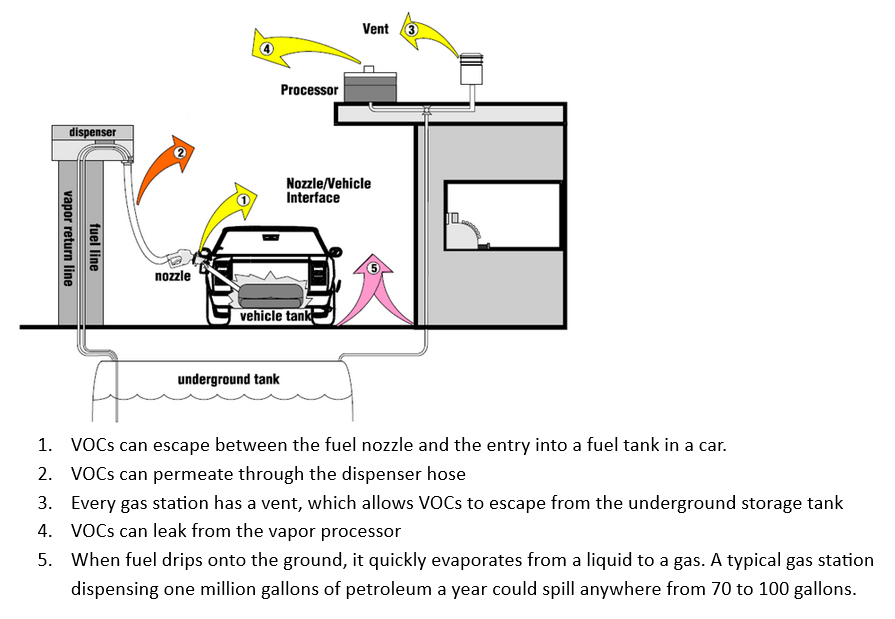
Sources: Yoon et al., 2010; Arif & Shah, 2007; Rumchev et al., 2004; Gordian et al., 2010; Delfino et al., 2003a; Delfino et al., 2003b; Billionnet et al., 2011; Hirsch et al., 1999; Bentayab et al., 2013; Sierra Club, 2004; Bolden et al., 2015)
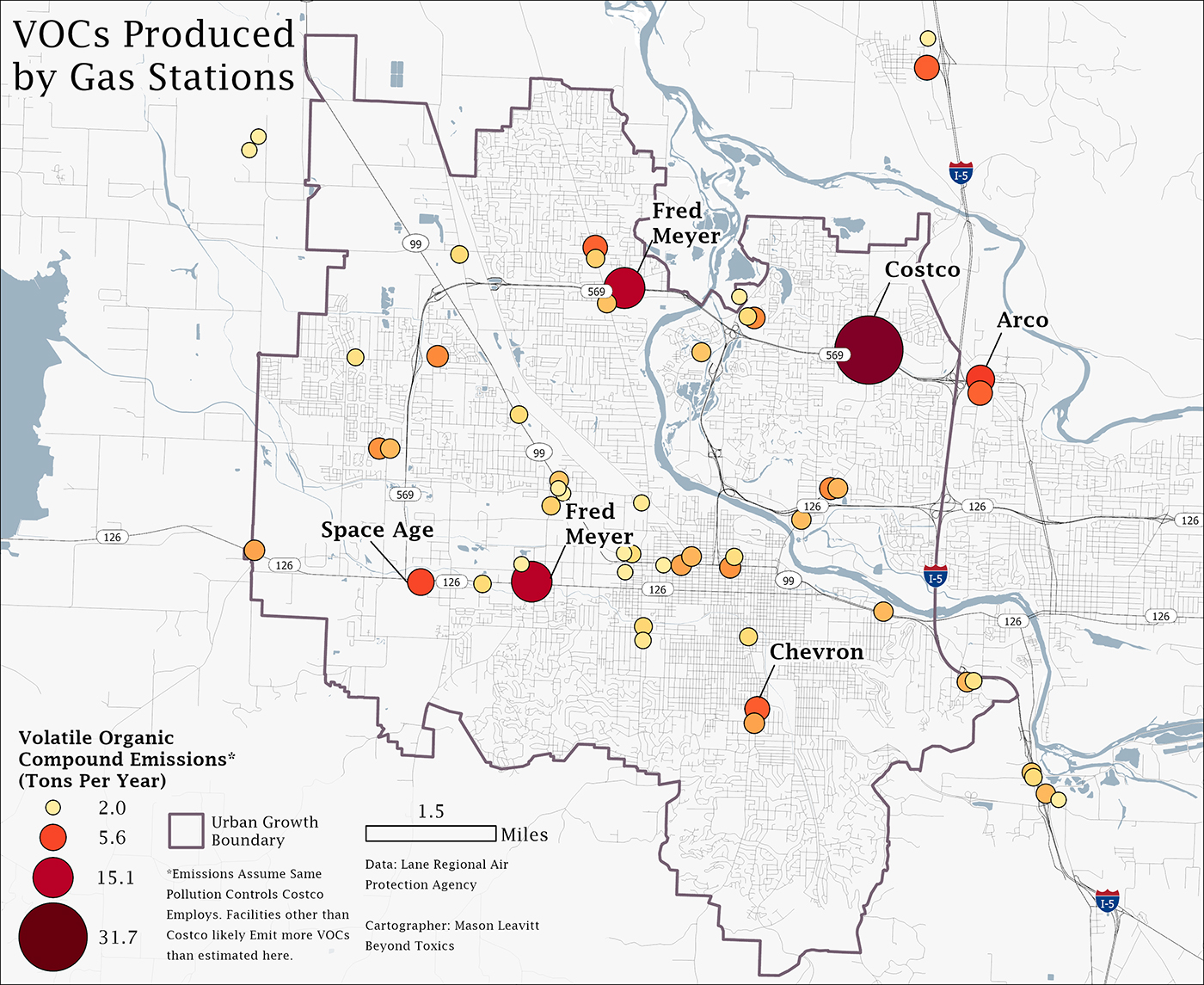
This map features Eugene gas stations as of November 2022. Circles are sized and colored depending on how many tons of VOCs a gas station emits in the year 2022. Costco, Fred Meyer, and Space Age all produced substantially more VOCs than their competitors.
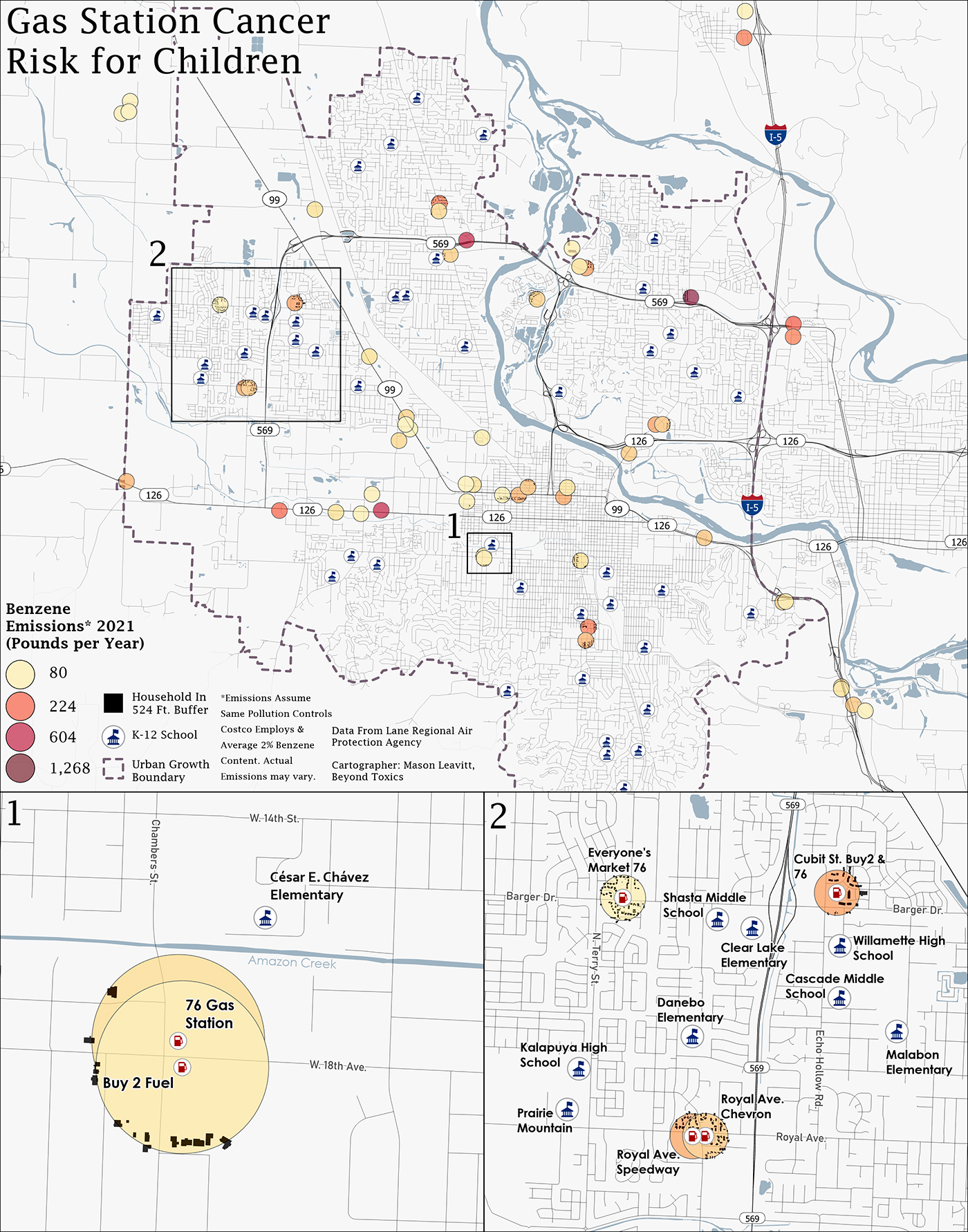
Two insets at the bottom draw attention to closely situated gas stations and schools along Chambers Street (left), and Barger Drive (right).
Underground Storage Tanks
Gas stations jeopardize human and environmental health because they frequently leak gasoline containing BTEX and hydrocarbons. These extremely hazardous chemicals soak into the soils underneath the station and infiltrate nearby properties.
Gas stations leak petroleum in two main ways: from the underground tank and at the pump itself. Most gas stations have two or three underground storage tanks, each of which holds 500 to 30,000 gallons of petroleum and can corrode over time.
If damaged, these tanks release petroleum into the surrounding soil that can migrate upwards of 500 feet and contaminate sources of drinking water and harm nearby ecosystems. For reference, just 10 gallons of petroleum has the potential to contaminate up to 12 million gallons of water.
Additionally, Volatile Organic Compounds in petroleum-contaminated soil can become airborne, and infiltrate the insides of nearby buildings, which exposes workers and residents to chronically harmful levels of BTEX. A recent example is the massive underground tank leak in Monmouth, where 14,000 gallons of petroleum contaminated ground water and soil in just five days (April 2021).
The gas station was deemed a total loss and had to be demolished, and nearby buildings were evacuated due to the risk of a fire or an explosion. The Oregon Department of Environmental Quality excavated thousands of cubic yards of contaminated soil.
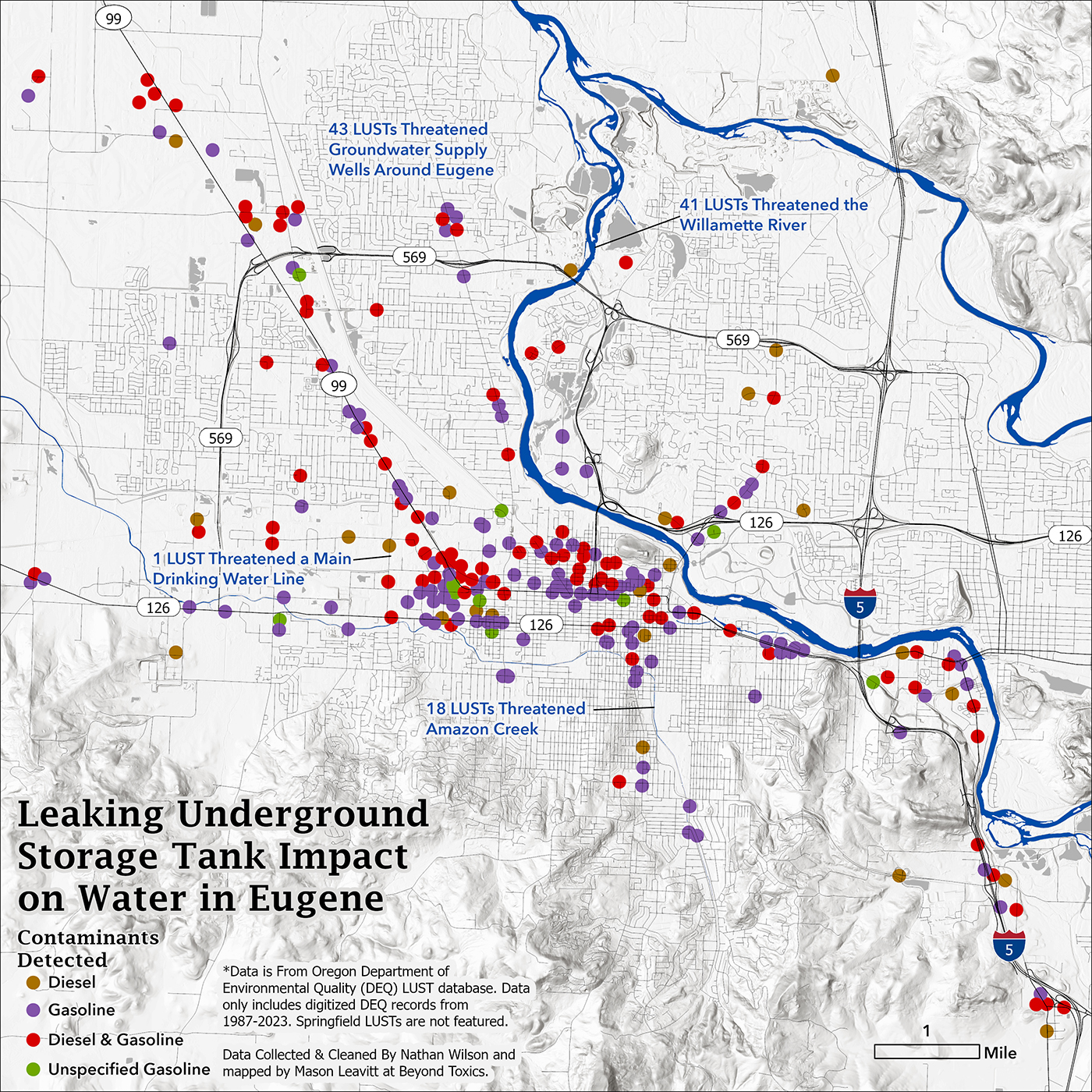
DEQ LUST cases by type of contaminant found in the soil upon the discovery of a petroleum leak. The most common hydrology threatened is groundwater wells for drinking water followed by the Willamette River.
Since 1987, there have been 303 releases from regulated underground storage tanks in Eugene alone. Cleaning up this contamination costs hundreds of thousands of dollars for each gas station, and they can take years, or even decades to clean up to safe levels. Leaks reduce nearby property values for all types of zoned land including residential, commercial, and industrial.
Oftentimes gas stations and environmental agencies agree to leave some contamination in place to reduce clean-up costs. This can mean the next owner of a former leak site will have to take more time and money to ensure the cleanup is completed up to regulatory standards for their new construction.
It is most common to discover leaks when gas stations are being demolished for another use. For example, an old large underground gasoline tank leaking dangerous vapors into nearby properties presented problems during the recent construction of 515 Broadway student apartments. The vapors were significant enough to cause the DEQ to prohibit residential units to be built on the ground floor.
Given that 80% of gas stations will likely be unprofitable in the next twelve years, we can assume that many will be decommissioned. The more gas stations we construct, the more cleanups we will have to pay for, the more soil and groundwater will be contaminated, and the more we will be moving in the opposite direction of a climate responsive and fossil free future.
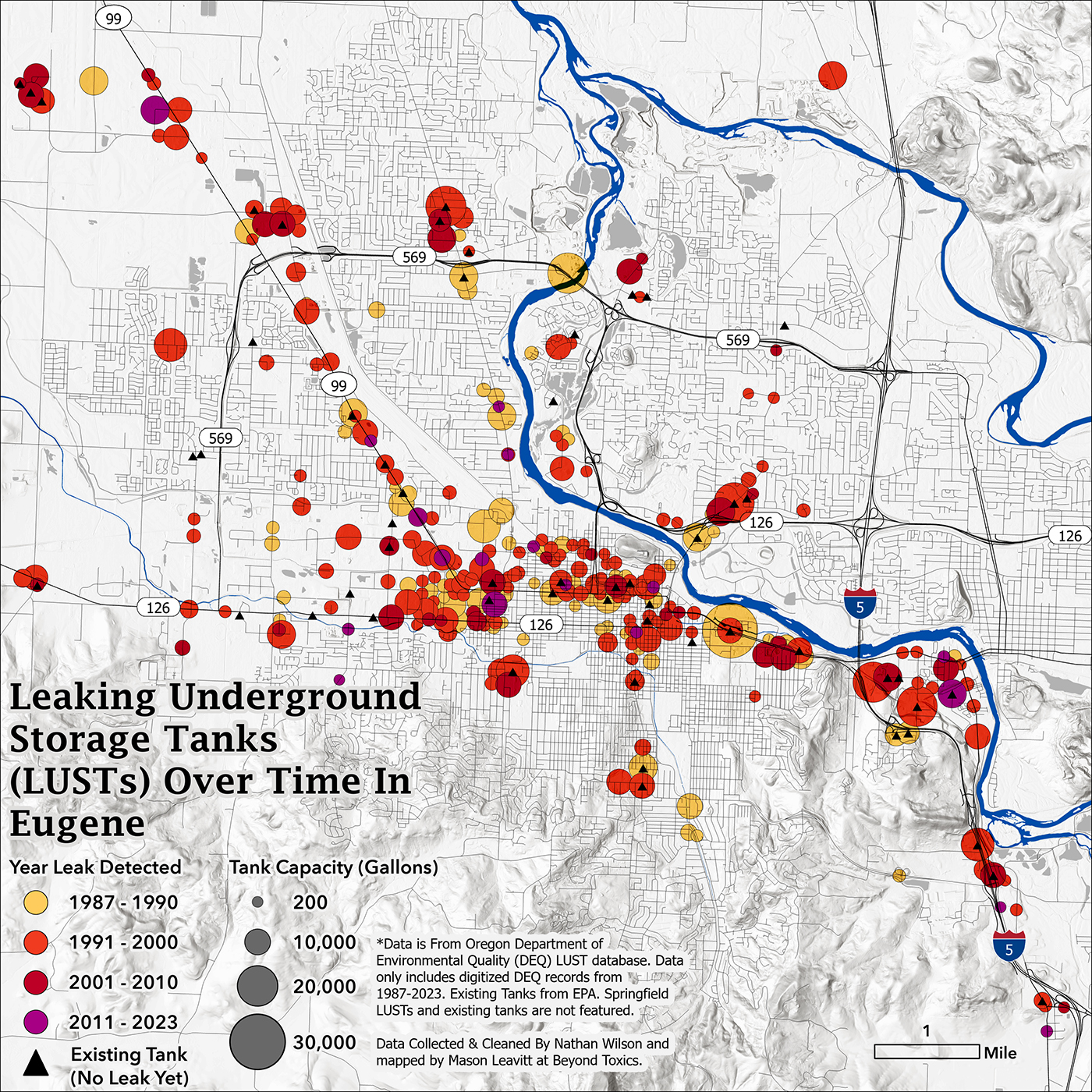
LUSTs over time in Eugene symbolized by the decade the leak was found and the capacity of tanks onsite at the time. This map does not feature any LUSTs prior to 1987, and it may not reflect every LUST in Eugene since 1987. Data was found through digitized records in the DEQ LUST database.