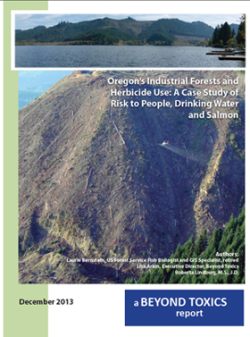
Oregon’s Industrial Forests and Herbicide Use
A case study of risk to people, drinking water, and salmon
The Case Study of Risk to People, Drinking Water and Salmon provides information regarding the use of herbicides on 184,320 acres of private industrial and state forestlands surrounding Triangle Lake, a rural area in western Lane County, Oregon.
In 2011, following complaints from rural residents about health problems that coincided with forestry aerial herbicide sprays, state and federal agencies launched the Highway 36 Corridor Public Health Exposure Investigation. The investigation resulted in the Oregon State Forester requiring pesticide applicators to turn over three years of forestry pesticide spray records from private and state timber operations (2009-2011).
Studying the spray records gathered during the Health Exposure Investigation provided new data, and a first-time review and analysis of industrial forestry herbicide practices.
This report raises public awareness and informs policy decisions about the associated risks of a common industrial forestry practice—aerially spraying herbicides over hundreds of thousands of forest and riparian acres.
Case Study Authors
Laurie Bernstein, US Forest Service Fish Biologist and GIS Specialist, retired
Lisa Arkin, then-Executive Director, Beyond Toxics
Roberta Lindberg, M.S., J.D.
Beyond Toxics Analysis of State Forest Herbicide Data
Beyond Toxics used the state's Forest Activity Electronic Reporting and Notifications System (FERNS) to find and analyze all herbicide sprays on state forests from 1/1/2020 through 8/30/2021. We presented our initial findings to the Board of Forestry on September 8, 2021.
We found that 34% of all sprays were performed by helicopter as aerial herbicide sprays in those 20 months. We also found that, on average, 4-6 ingredients are combined in one tank mix and applied to state forest lands, despite the lack of research showing that such chemical concoctions are safe to spray in watersheds or wildlife habitat areas.
The presentation was accompanied by a request to place a 2-year moratorium on aerial pesticide sprays and initiate a comprehensive analysis of the impacts of aerial pesticide spray to watershed, community, and environmental health.
Over 200 Oregonians submitted comments to the Board of Forestry sharing these concerns and supporting our request.