Protecting Watersheds in Oregon's State Forests
Current logging and pesticide laws do not protect critical Oregon watersheds
State forests are highly valued as wildlife habitat, protection of viable watersheds for fish and drinking water, and places to hike, camp, fish, picnic or seek peace and quiet. Yet, the Oregon Department of Forestry manages our public state forests more like industrial timber tracts rather than for healthy ecosystems.
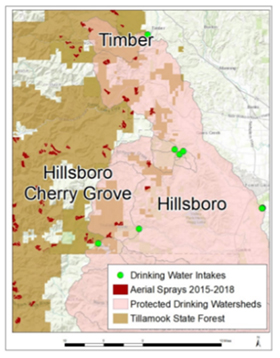
Oregonians are deeply concerned about the practice of steep-slope clear cuts near salmon habitat streams and drinking water sources and spraying pesticides on clear cuts. Pesticides do not stay in one place. Toxic residues can travel for miles as vapors or droplets on wind currents. Pesticides known to harm people and fish can make their way into streams from run-off and deposition.
Our state forests should be managed sustainably for carbon storage, clean rivers and streams, wildlife habitat and diverse tree and plant ecosystems.
What We Are Doing
Beyond Toxics has worked directly with impacted communities who believe that the Oregon Department of Forestry is not doing enough to protect their drinking water sources, their air, and the forest ecosystem that rural economies depend upon. Neither is the Agency doing enough to prevent erosion, landslides and ecosystem decline.
We involve rural communities to work with us gathering the necessary data, mapping and analysis to make the case for forest management that prioritizes clean water, carbon storage and drawdown, safe communities and vibrant ecosystems for the next generations of Oregonians.
In fall 2021, we compiled and presented our findings about the Department of Forestry's herbicide application practices in watersheds that provide essential fish habitat and crucial drinking water sources.
Resources
September 8, 2021 Board of Forestry meeting
November 3, 2021 Board of Forestry Meeting (Beyond Toxics testimony starts at 37:30)
Our Findings
Beyond Toxics September Testimony to the Board of Forestry (9/8/21) - PDF
Beyond Toxics used the state's Forest Activity Electronic Reporting and Notifications System (FERNS) to find and analyze all herbicide sprays on state forests from 1/1/2020 through 8/30/2021. We presented our initial findings to the Board of Forestry on September 8, 2021.
We found that 34% of all sprays were performed by helicopter as aerial herbicide sprays in those 20 months. We also found that, on average, 4-6 ingredients are combined in one tank mix and applied to state forest lands, despite the lack of research showing that such chemical concoctions are safe to spray in watersheds or wildlife habitat areas.
The presentation was accompanied by a request to place a 2-year moratorium on aerial pesticide sprays and initiate a comprehensive analysis of the impacts of aerial pesticide spray to watershed, community, and environmental health.
Over 200 Oregonians submitted comments to the Board of Forestry sharing these concerns and supporting our request.
Beyond Toxics November Testimony to the Board of Forestry (11/3/21) - PDF
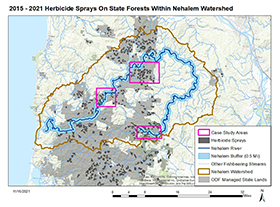
Building on our September presentation to the Board of Forestry, Beyond Toxics presented a case study of the Nehalem Watershed to the Board on November 3, 2021. We sent the Board a set of maps we created using data obtained from FERNS depicting pesticide applications in the Nehalem Watershed from 2015-2021, covering Astoria, Tillamook, and Forest Grove Districts.
Our goal was to use this case study focused on the headwaters and other stretches of the Nehalem River to help the Board, Department staff, and public visualize where pesticide sprays take place, note their close proximity to important fish-bearing streams, and consider related impacts, such as drinking water pollution, greenhouse gas emissions, soil depletion, and degradation of habitat for fish, wildlife, and native pollinators.
We reiterated our request to the Board to place a two-year moratorium on aerial pesticide sprays in state forestlands and initiate a comprehensive analysis of the impacts of aerial pesticide spray to watershed, community, and environmental health.