Solid Waste Task Force Hearing Action Alert
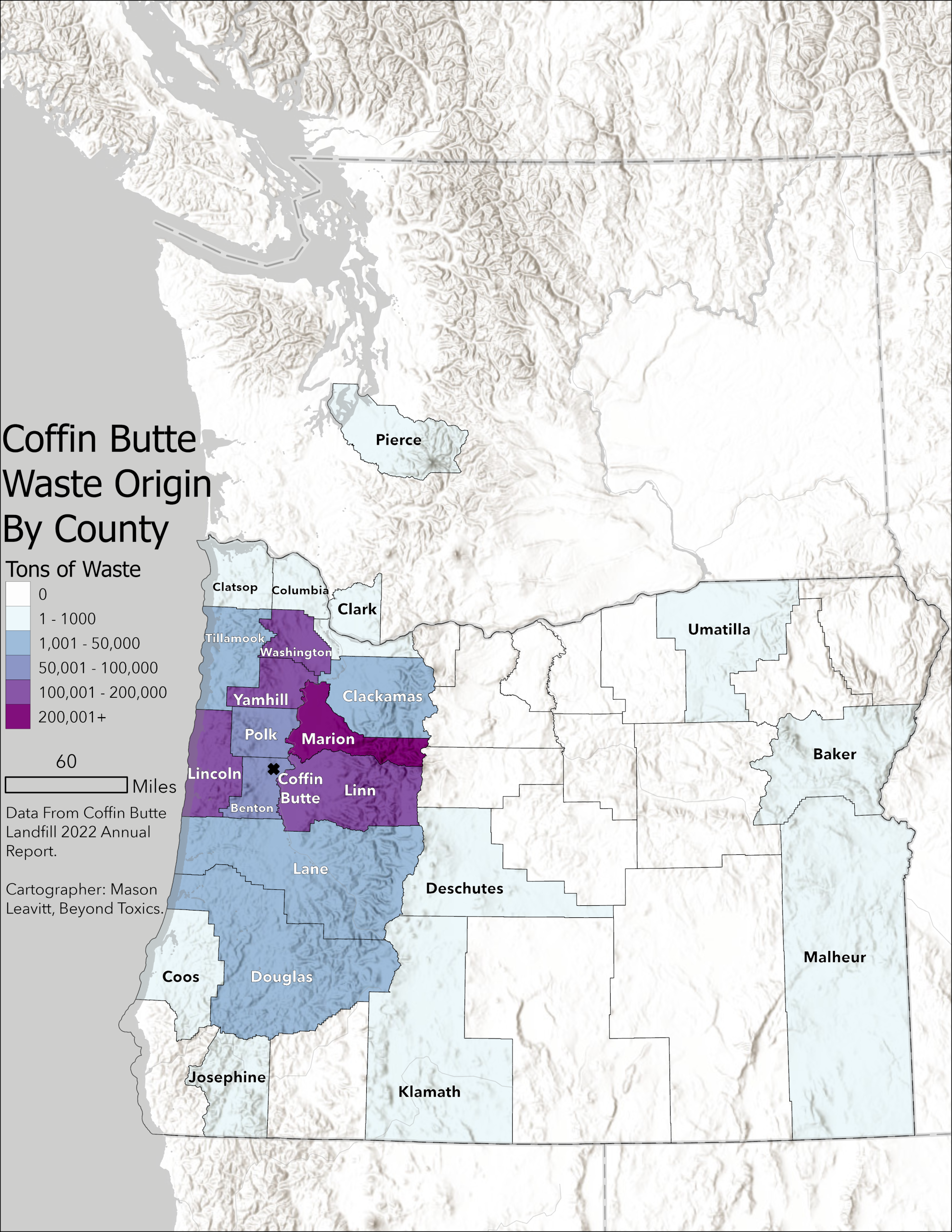
The Willamette Valley Task Force on Waste Management was established by HB 3974 to come up with a regional waste management plan for the closure of Coffin Butte Landfill, which is expected in the 2030s. Coffin Butte currently serves the entirety of Linn, Benton, Yamhill, Lincoln, and Tillamook Counties while being a major destination for trash originating from Marion and Washington counties. While a closure date seems far off, 10 years is a tight timeline for such a large transition.
The vast majority of currently approved empty landfill space in Oregon lies east of the Cascade Mountains while most waste generation occurs in the Willamette Valley. It will take major infrastructural investments to create a spoke and hub system capable of centralizing waste streams from the counties currently served by Coffin Butte and shipping out east. This major investment is a once-in-a-lifetime opportunity, and it needs to come alongside investments in greener waste management.
The task force will be meeting throughout the rest of the year before landing on a final recommendation to the legislature for the 2027 session. This is the first opportunity for public testimony before the task force and a critical time to ensure environmental health and sustainability are a focus of that recommendation.
Details
Testimony can be submitted by writing and orally to the task force. Oral testimony can be given by Zoom and in person at the Oregon State Capitol.
To give oral testimony, you must register before 12:30 p.m. on the day of the hearing. Oral public testimony will occur as the last item of the hearing which we estimate will start around 3:00/3:30 p.m.
Sample Talking Points
Make Waste Diversion A Priority
In their meetings to date, the committee has debated whether to make waste diversion a focal point of their recommendation. Some committee members have advocated increased recycling and composting as critical measures to ensure sustainable outcomes and reduce the carbon and monetary costs associated with shipping solid waste to Eastern Oregon landfills. Other committee members have pushed back against such “prescriptive” measures. This is an excellent opportunity to let the committee know that waste diversion is an essential priority for safer, greener, and sustainable waste management.
Infrastructure Investment
Right now, many communities can send their neighborhood local hauling trucks directly to Coffin Butte Landfill for disposal. While this practice is not environmentally friendly, since hauling trucks are incredibly fuel inefficient per ton of waste, it does avoid investing in transfer station infrastructure, which can be a significant cost to local governments. However, this lack of investment is not an option going forward into a post Coffin Butte reality.
Transfer stations are a key infrastructure that can centralize waste from local hauling operations and members of the public who need to dispose of waste directly. This waste can then be compacted and hauled to its next destination on larger vehicles, which achieve more fuel efficiency per ton of waste and thus reduced greenhouse gas emissions. Research also shows that accessible waste disposal decreases illegal dumping and many hauling stations can be critical collection points for centralizing recyclable materials and hazardous waste.
Ensuring that transfer stations are accessible to both urban and rural communities needs to be a key priority of the task force. Requiring transfer stations to also collect recycling is critical, and also requiring that transfer stations host hazardous waste collection events once at least once a year ensures that residents have an affordable and convenient option to correctly dispose of dangerous items.
Flow Control
In order to pay and operate solid waste infrastructure, such as transfer stations and waste diversion facilities, there needs to be a guaranteed flow of garbage to those operations. Financing is often derived from fees on waste passing through the facility, and waste diversion facilities often also depend on revenue from generated recyclable materials. Without flow control, waste haulers can choose to bring waste elsewhere, which can undermine infrastructure and waste diversion projects. In order to ensure that waste management is driven by community priorities, and not just profit motivations, it is essential to create governmental agreements around waste flows to ensure smooth operations. Lane County is currently experiencing difficulty in getting a new recycling operation off the ground due in part to a lack of flow control for the cities of Springfield and Cottage Grove. The hauler for those cities has chosen profit over sustainability by choosing to haul waste 200 miles south to Medford where they deposit the waste in their own landfill. It is critical that the task force avoid creating circumstances that enable similar behavior.
Regional Cooperation
Many cities and unincorporated communities, governed at the county level, do not have the population and waste generation to support cost effective waste diversion facilities on their own. Regional cooperation can allow cities and counties to work together in creating coordinated waste infrastructure and solid waste management to unlock the cost savings benefits of economies of scale. A regional waste authority would create an official mechanism for the governments of Tillamook, Lincoln, Linn, Benton, Marion, Polk, Yamhill, and the dozens of cities in those counties, to work together in creating a coordinated waste management plan. A regional waste authority has the capacity to bring together the current waste stream of 1.1 million tons per year headed towards Coffin Butte Landfill, and ensure most of that waste is brought to a waste diversion center before remaining waste that can’t be recovered is shipped to current landfill space in Eastern Oregon. Without regional cooperation, rural counties will not likely be able to invest in diversion infrastructure on their own. A regional waste authority can be a critical governance tool in coordinating waste streams, ensuring flow control, and achieving economic efficiency that more populated counties can accomplish on their own.